Tap the milestone you’d like to explore below
Milestones by 2 Months
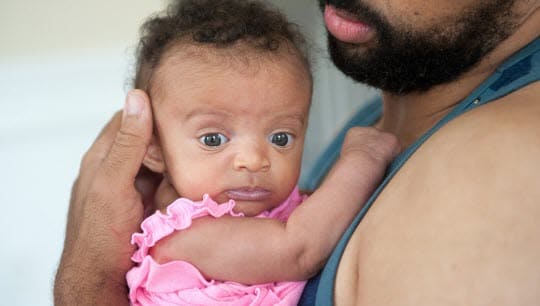
Want to see these milestones in action? Download CDC’s free Milestone Tracker app or view them here:
Social/Emotional Milestones
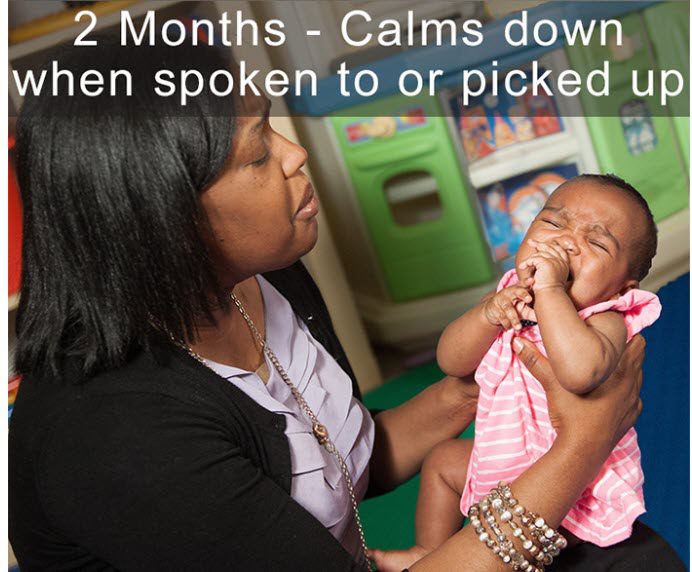
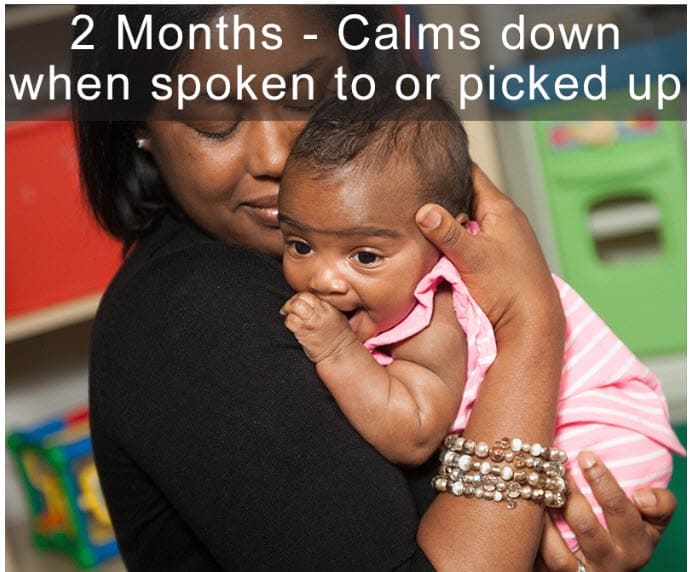
Calms down when spoken to or picked up
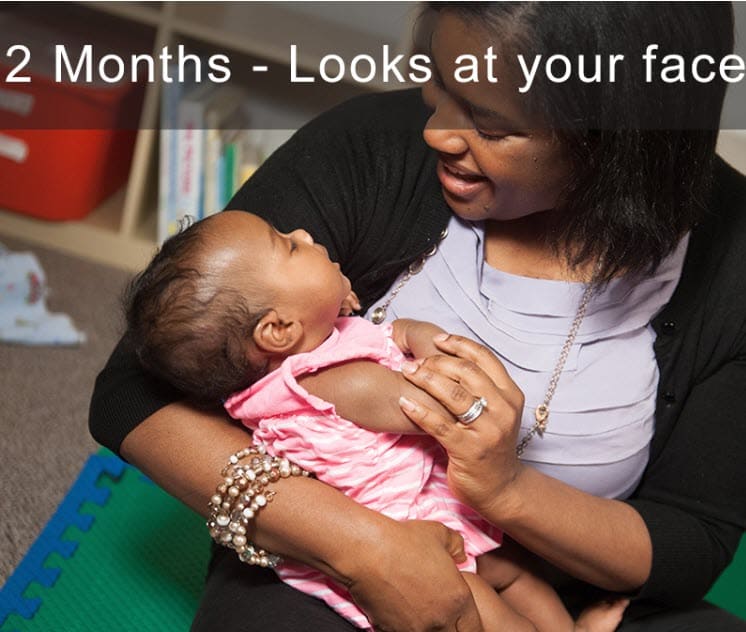
Looks at your face
Seems happy to see you when you walk up to her
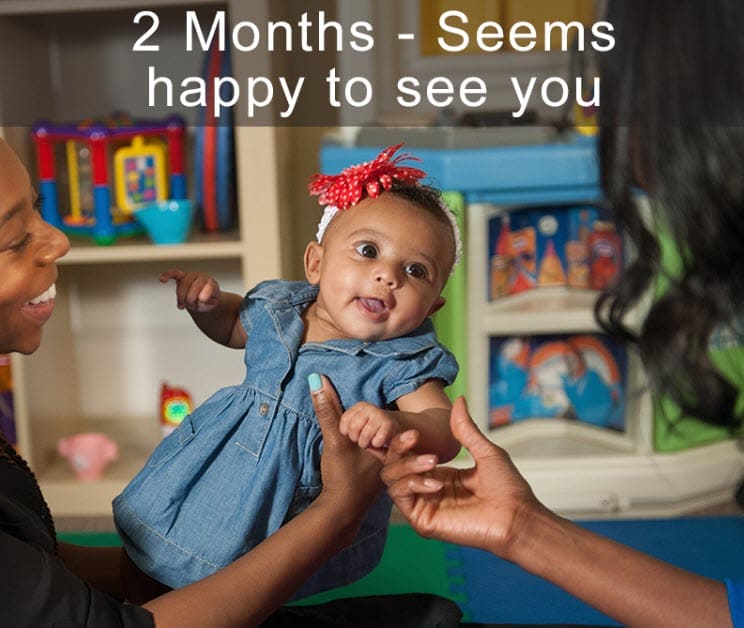
Smiles when you talk to or smile at her
Language/Communication Milestones
Makes sounds other than crying
Reacts to loud sounds
Cognitive Milestones (learning, thinking, problem-solving)
Watches you as you move
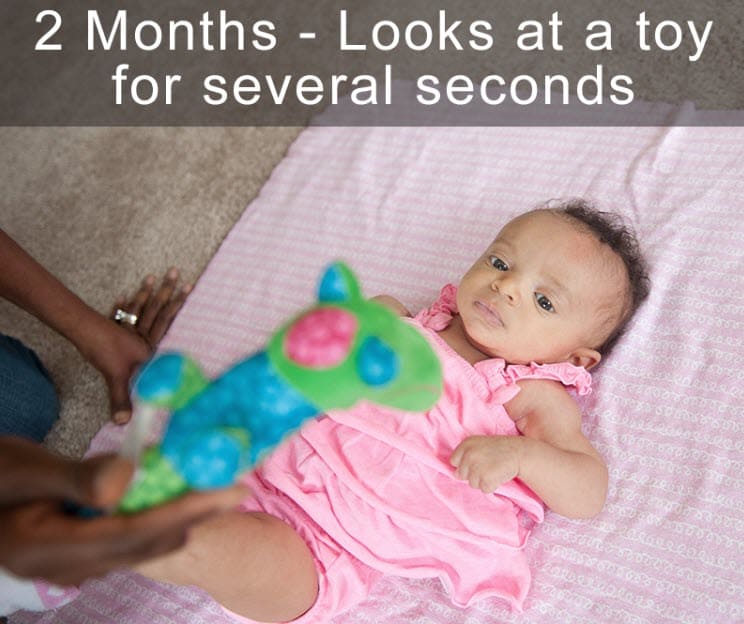
Looks at a toy for several seconds
Movement/Physical Development Milestones
Holds head up when on tummy

Moves both arms and both legs
Opens hands briefly
Tips and Activities to Support Your Child’s Development at 2 Months
- Respond positively to your baby. Act excited, smile, and talk to him when he makes sounds. This teaches him to take turns "talking" back and forth in conversation.
- Talk, read, and sing to your baby to help her develop and understand language.
- Spend time cuddling and holding your baby. This will help him feel safe and cared for. You will not spoil your baby by holding or responding to him.
- Being responsive to your baby helps him learn and grow. Limiting your screen time when you are with your baby helps you be responsive.
- Take care of yourself. Parenting can be hard work! It's easier to enjoy your new baby when you feel good yourself.
- Learn to notice and respond to your baby's signals to know what she's feeling and needs. You will feel good and your baby will feel safe and loved. For example, is she trying to "play" with you by making sounds and looking at you, or is she turning her head away, yawning, or becoming fussy because she needs a break?
- Lay your baby on his tummy when he is awake and put toys at eye level in front of him. This will help him practice lifting his head up. Do not leave your baby alone. If he seems sleepy, place him on his back in a safe sleep area (firm mattress with no blankets, pillows, bumper pads, or toys).
- Feed only breast milk or formula to your baby. Babies are not ready for other foods, water or other drinks for about the first 6 months of life.
- Learn when your baby is hungry by looking for signs. Watch for signs of hunger, such as putting hands to mouth, turning head toward breast/bottle, or smacking/licking lips.
- Look for signs your baby is full, such as closing her mouth or turning her head away from the breast/bottle. If your baby is not hungry, it's ok to stop feeding.
- Do not shake your baby or allow anyone else to—ever! You can damage his brain or even cause his death. Put your baby in a safe place and walk away if you're getting upset when he is crying. Check on him every 5–10 minutes. Infant crying is often worse in the first few months of life, but it gets better!
- Have routines for sleeping and feeding. This will help your baby begin to learn what to expect.
- Hold a rattle off to one side of your baby's head, shake it, and see if your baby looks for the noise
- Practice staying calm when your baby is upset by talking softly, holding, rocking, or singing to her. This will help her calm down and lessen her stress and fears.
- Limit screen time (TV, tablets, phones, etc.) to video calling with loved ones. Screen time is not recommended for children younger than 2 years of age. Babies learn by talking, playing, and interacting with others.
- Talk and play with your baby while feeding, dressing, and bathing.
- Help your baby learn some ways to self-soothe by letting her suck on her fingers or a pacifier.
- Copy your baby's sounds and see how long your baby "talks" by making sounds back and forth with you.
- Place a baby-safe mirror near your baby so she can look at herself. She will begin to develop a sense of who she is.
- Look at pictures with bright colors or faces with your baby and talk about them.
Answer a few questions?
Milestones by 4 Months

Want to see these milestones in action? Download CDC’s free Milestone Tracker app or view them here:
Social/Emotional Milestones
Language/Communication Milestones
Cognitive Milestones (learning, thinking, problem-solving)
Movement/Physical Development Milestones
Tips and Activities to Support Your Child’s Development at 4 Months
Answer a few questions?
Milestones by 6 Months
Want to see these milestones in action? Download CDC’s free Milestone Tracker app or view them here:
Social/Emotional Milestones
Language/Communication Milestones
Cognitive Milestones (learning, thinking, problem-solving)
Movement/Physical Development Milestones
Tips and Activities to Support Your Child’s Development at 4 Months
Answer a few questions?
Milestones by 9 Months
Want to see these milestones in action? Download CDC’s free Milestone Tracker app or view them here: