
Milestones by 4 Months
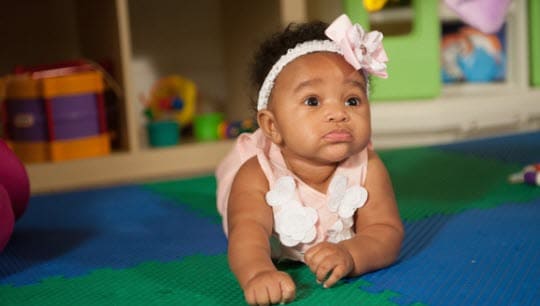
Milestones, tips, and images provided by CDC’s Learn the Signs. Act Early. Program.
Social/Emotional Milestones
Smiles on his own to get your attention
Chuckles (not yet a full laugh) when you try to make him laugh
Looks at you, moves, or makes sounds to get or keep your attention
Language/Communication Milestones
Makes sounds like “oooo”, “aahh” (cooing)
Makes sounds back when you talk to him
Turns head towards the sound of your voice
Cognitive Milestones (learning, thinking, problem-solving)
If hungry, opens mouth when he sees breast or bottle

Looks at her hands with interest
Movement/Physical Development Milestones
Holds head steady without support when you are holding him
Holds a toy when you put it in his hand
Uses his arm to swing at toys
Brings hands to mouth
Pushes up onto elbows/forearms when on tummy

Tips and Activities to Support Your Child’s Development at 4 Months
- Respond positively to your baby. Act excited, smile, and talk to him when he makes sounds. This teaches him to take turns "talking" back and forth in conversation.
- Provide safe opportunities for your baby to reach for toys, kick at toys and explore what is around her. For example, put her on a blanket with safe toys.
- Allow your baby to put safe things in his mouth to explore them. This is how babies learn. For example, let him see, hear, and touch things that are not sharp, hot, or small enough to choke on.
- Talk, read, and sing to your baby. This will help her learn to speak and understand words later.
- Limit screen time (TV, phones, tablets, etc.) to video calling with loved ones. Screen time is not recommended for children younger than 2 years of age. Babies learn by talking, playing, and interacting with others.
- Feed only breast milk or formula to your baby. Babies are not ready for other foods, water or other drinks for about the first 6 months of life.
- Give your baby safe toys to play with that are easy to hold, like rattles or cloth books with colorful pictures for her age.
- Let your baby have time to move and interact with people and objects throughout the day. Try not to keep your baby in swings, strollers, or bouncy seats for too long.
- Set steady routines for sleeping and feeding.
- Lay your baby on her back and show her a bright-colored toy. Move the toy slowly from left to right and up and down to see if she watches how the toy moves.
- Sing and talk to your baby as you help her "exercise" (move her body) for a few minutes. Gently bend and move her arms and legs up and down.
- Play with your baby by holding him securely under his arms with his feet on your lap. Let him bounce up and down.
- Play games, such as peek-a-boo. You can cover your eyes with your hands and then uncover and say "peek-a-boo." Watch for your baby's smile or other signs he is enjoying the game.
- Pay close attention to how your baby reacts to different things. This will help you learn what she likes and doesn't like and what makes her feel good.
- Copy your baby's sounds and see how long your baby "talks" back and forth with you.
- Call your baby by his name to help him learn it. He will start to recognize it around 9 months. For example, "Are you ticklish, Jordan?"
- Playing on the floor or play mat with your baby every day helps him to move, learn, and explore.
- Hold and talk to your baby; smile and be cheerful while you do.
- Have quiet play times when you "read" or sing to your baby.
Answer a few questions?
Select the age of your child to see their Milestones
6 Months
9 Months

1 Year

15 Months

18 Months

2 Years

30 Months

3 Years

4 Years

5 Years

2 Months