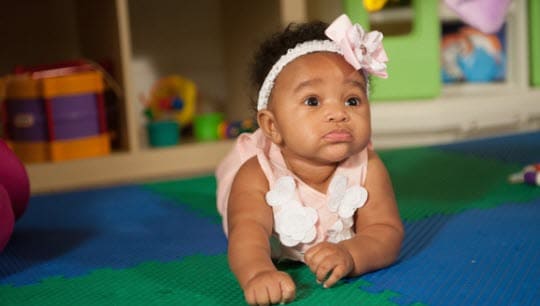
Milestones by 1.5 Year/18 Months

Milestones, tips, and images provided by CDC’s Learn the Signs. Act Early. Program.
Social/Emotional Milestones
Moves away from you, but looks to make sure you are close by
Points to show you something interesting

Puts hands out for you to wash them

Looks at a few pages in a book with you

Helps you dress him by pushing arm through sleeve or lifting up foot
Language/Communication Milestones
Tries to say three or more words besides “mama” or “dada”
Follows one-step directions without any gestures, like giving you the toy when you say, “Give it to me.”
Cognitive Milestones (learning, thinking, problem-solving)
Copies you doing chores, like sweeping with a broom
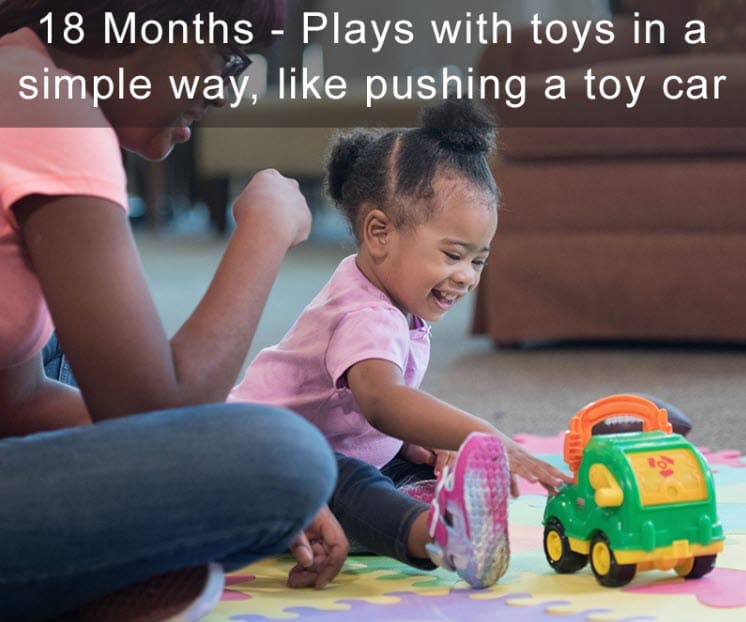
Plays with toys in a simple way, like pushing a toy car

Movement/Physical Development Milestones
Walks without holding on to anyone or anything
Scribbles

Drinks from a cup without a lid and may spill sometimes

Feeds himself with his fingers

Tries to use a spoon

Climbs on and off a couch or chair without help

Tips and Activities to Support Your Child’s Development at 18 Months/1.5 Years
- Use positive words and give more attention to behaviors you want to see ("wanted behaviors"). For example, "Look how nicely you put the toy away." Give less attention to those you don't want to see.
- Encourage "pretend" play. Give your child a spoon so she can pretend to feed her stuffed animal. Take turns pretending.
- Help your child learn about others' feelings and about positive ways to react. For example, when he sees a child who is sad, say "He looks sad. Let's bring him a teddy."
- Ask simple questions to help your child think about what's around her. For example, ask her, "What is that?"
- Let your child use a cup without a lid for drinking and practice eating with a spoon. Learning to eat and drink is messy but fun!
- Give simple choices. Let your child choose between two things. For example, when dressing, ask him if he wants to wear the red or blue shirt.
- Have steady routines for sleeping and eating. For example, sit at the table with your child when she's eating meals and snacks. This helps set mealtime routines for your family.
- Limit screen time (TV, tablets, phones, etc.) to video calling with loved ones. Screen time is not recommended for children younger than 2 years of age. Children learn by talking, playing, and interacting with others. Limit your own screen time when you are with your child so you are able to respond to her words and actions.
- Ask your child's doctor and/or teachers if your child is ready for toilet training. Most children are not successful at toilet training until 2 to 3 years old. If he is not ready, it can cause stress and setbacks, which can cause training to take longer.
- Expect tantrums. They are normal at this age and should become shorter and happen less often as your child gets older. You can try distractions, but it's ok to ignore the tantrum. Give him some time to calm down and move on.
- Talk with your child by facing her and getting down to her eye level when possible. This helps your child "see" what you're saying through your eyes and face, not just your words.
- Start to teach your child the names for body parts by pointing them out and saying things like "Here's your nose, here's my nose," while pointing to her nose and your own.
- Try to respond to your child's behavior in a safe, and loving way. Stay consistent as much as possible.
- Teach your child more words by adding to the words she says. For example, if she says "Dog," say "Yes, that's a dog. Dogs say 'woof, woof.'"
- Play with your child by rolling balls back and forth, pushing toy cars, and putting blocks or other items in and out of containers.
- Read books and talk about the pictures using simple words.
- Play simple games where both of you have a part to play. Blow bubbles and let your child pop them. Say things as he pops them, such as "Pop, pop."
- Create a spot in your home for your child to go to when he's upset. Stay nearby so your child knows he is safe and can come to you for help calming as needed.
- Give toys that your child can push or pull safely.
- Give toys and things to your child that encourage "pretend" play, such as a doll and a baby blanket.
Answer a few questions?
Select the age of your child to see their Milestones
6 Months
9 Months

1 Year

15 Months
18 Months

2 Years

30 Months

3 Years

4 Years

5 Years
2 Months