Milestones by 3 Years
Milestones, tips, and images provided by CDC’s Learn the Signs. Act Early. Program.
Social/Emotional Milestones
Calms down within 10 minutes after you leave her, like at a childcare drop off
Notices other children and joins them to play
Language/Communication Milestones
Talks with you in conversation using at least two back-and-forth exchanges
Asks “who,” “what,” “where,” or “why” questions, like “Where is mommy/daddy?”
Says what action is happening in a picture or book when asked, like “running,” “eating,” or “playing”
Says first name, when asked
Talks well enough for others to understand, most of the time
Cognitive Milestones (learning, thinking, problem-solving)
Draws a circle, when you show him how
Avoids touching hot objects, like a stove, when you warn her
Movement/Physical Development Milestones
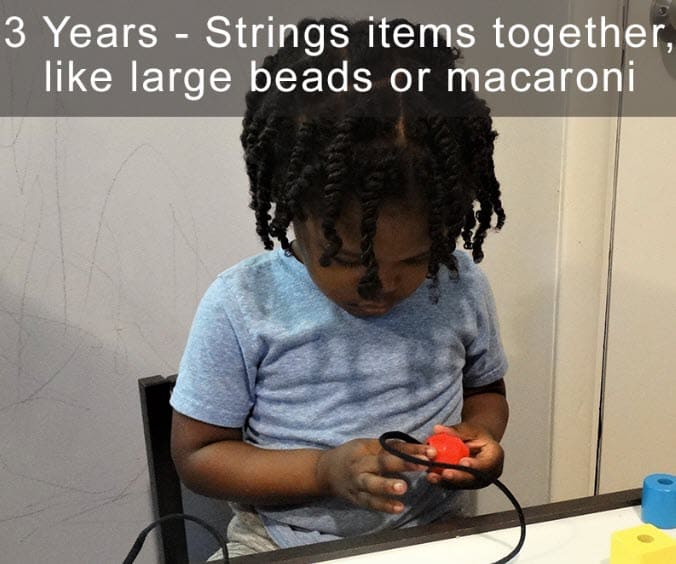
Strings items together, like large beads or macaroni
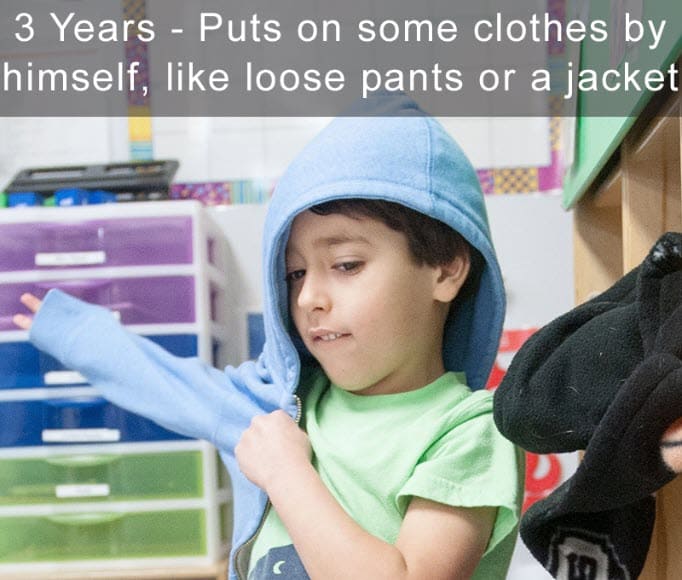
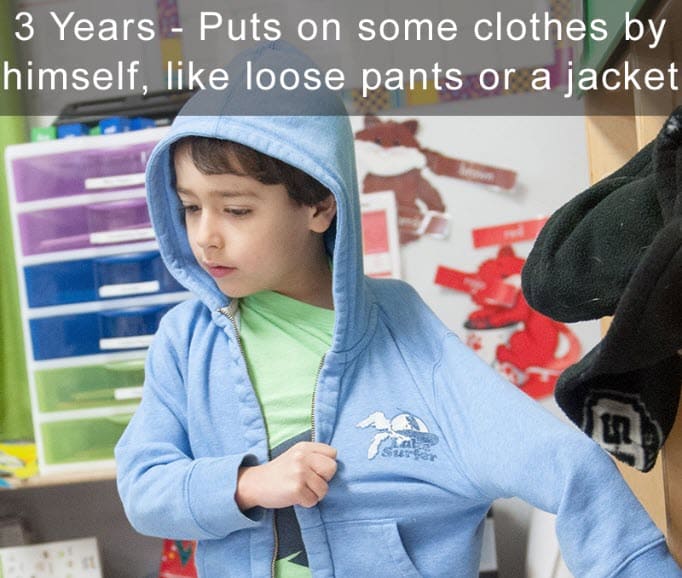
Puts on some clothes by himself, like loose pants or a jacket
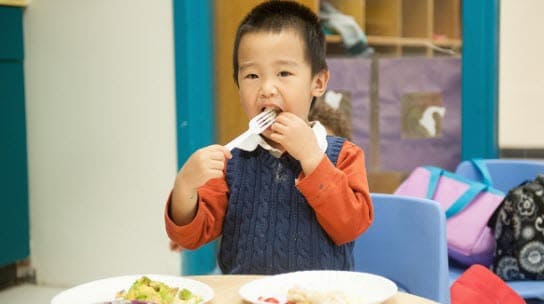
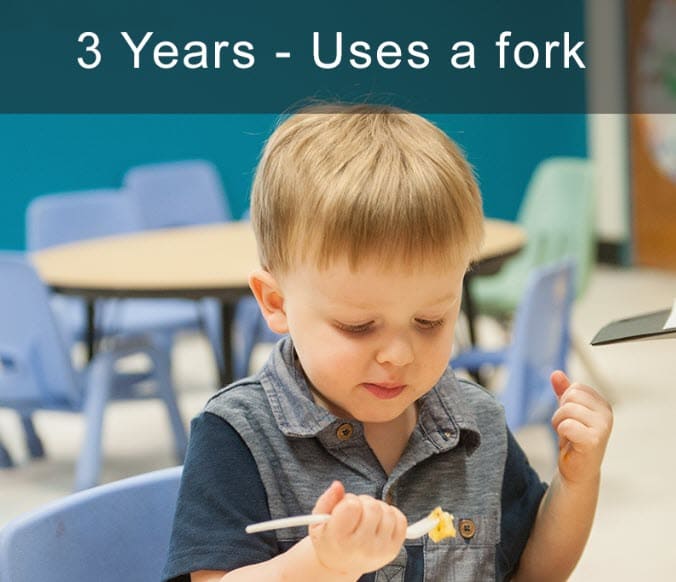
Uses a fork
Tips and Activities to Support Your Child’s Development at 3 Years
- Encourage your child to solve her own problems with your support. Ask questions to help her understand the problem. Help her think of solutions, try one out, and try more if needed.
- Talk about your child's emotions and give him words to help him explain how he's feeling. Help your child manage stressful feelings by teaching him to take deep breaths, hug a favorite toy, or go to a quiet, safe place when he is upset.
- Set a few simple and clear rules that your child can follow, such as use gentle hands when playing. If he breaks a rule, show him what to do instead. Later, if your child follows the rule, recognize and congratulate him.
- Ask your child simple questions about books and stories. Ask questions, such as "Who?" "What?" and "Where?"
- Help your child learn how to play with other children. Show him how by helping him share, take turns, and use his "words."
- Let your child "draw" with crayons on paper, shaving cream on a tray, or chalk on a sidewalk. If you draw a straight line, see if she will copy you. When she gets good at lines, show her how to draw a circle.
- Let your child play with other children, such as at a park or library. Ask about local play groups and pre-school programs. Playing with others helps him learn the value of sharing and friendship.
- Eat family meals together as much as you can. Give the same meal to everyone. Enjoy each other's company and avoid screen time (TV, tablets, and phones, etc.) during meals.
- Limit screen time (TV, tablets, phones, etc.) to no more than 1 hour per day of a children's program with an adult present. Children learn by talking, playing, and interacting with others.
- Use words to describe things to your child, such as big/small, fast/slow, on/off, and in/out.
- Help your child do simple puzzles with shapes, colors, or animals. Name each piece when your child puts it in place.
- Play with your child outside. For example, take your child to the park to climb on equipment and run in safe areas.
- Allow your child to eat as much or as little as she wants at each meal. Your job is to offer her healthy foods and it's your child's job to decide if and how much she wants to eat.
- Ask your child's doctor and/or teachers about toilet training to know if your child is ready to start. Most children are not able to toilet train until 2 to 3 years old. Starting too early can cause stress and setbacks, which can cause training to take longer.
- Let your child play with large boxes. He can pretend it is a car, bus, train, or house. Let him color, paint it, and put stickers on it.
- Play with your child outside by playing "ready, set, go." For example, pull your child back in a swing. Say "Ready, set...", then wait and say "Go" when you push the swing.
- Encourage your child to name colors, body parts, and pictures in books.
- Kick a ball back and forth with your child. When your child is good at that, show her how to run and kick the ball.
- Have steady routines for sleeping and feeding. Create a calm, quiet bedtime for your child. Put on her pajamas, brush her teeth, and read 1 or 2 books to her. Children this age need 11 to 14 hours of sleep a day (including naps). Consistent sleep times make it easier.
- Play "follow the leader" with your child. Walk in a straight line, make turns, walk backwards, and walk on tiptoes. Let your child lead after you show him how.
- Read to your child and visit the local library. This will help your child enjoy reading and be ready to read when she is older.
- Encourage "pretend" play. For example, let your child pretend to cook using safe things from your kitchen.
- Show your child how to turn pages in a book or magazine.
Answer a few questions?
Select the age of your child to see their Milestones
6 Months
9 Months

1 Year

15 Months

18 Months

2 Years

30 Months

3 Years

4 Years

5 Years
2 Months