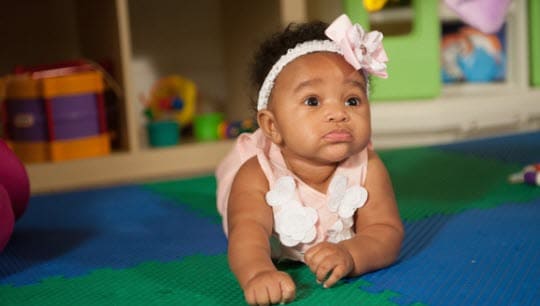
Milestones by 6 Months
Milestones, tips, and images provided by CDC’s Learn the Signs. Act Early. Program.
Social/Emotional Milestones
Knows familiar people


Likes to look at self in a mirror

Laughs
Language/Communication Milestones
Takes turns making sounds with you
Blows “raspberries” (sticks tongue out and blows)
Makes squealing noises
Cognitive Milestones (learning, thinking, problem-solving)
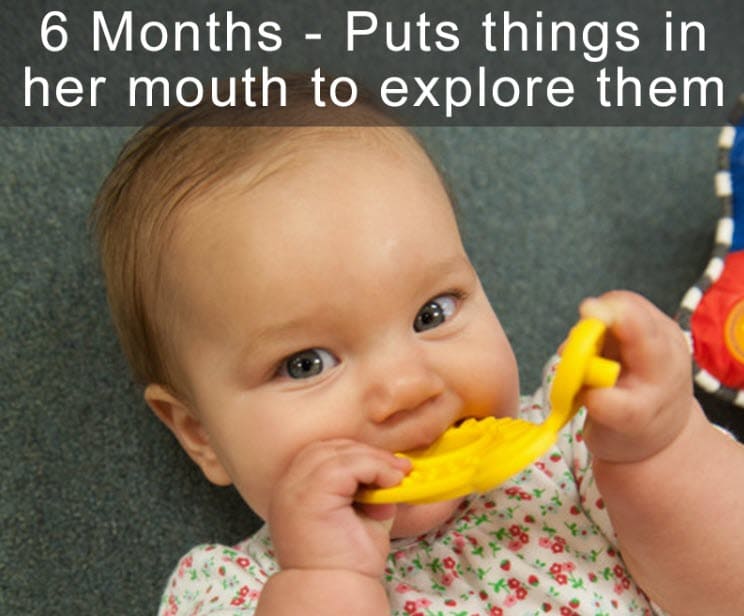
Puts things in her mouth to explore them
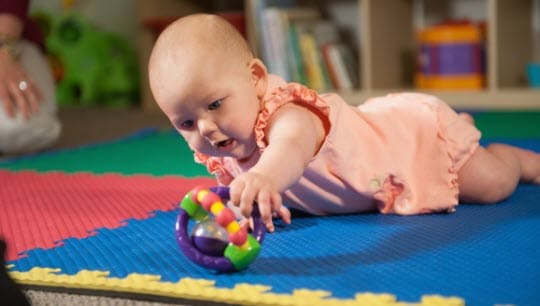
Reaches to grab a toy she wants

Closes lips to show she doesn’t want more food
Movement/Physical Development Milestones
Rolls from tummy to back
Pushes up with straight arms when on tummy

Leans on hands to support herself when sitting

Tips and Activities to Support Your Child’s Development at 6 Months
- Use "back and forth" play with your baby. When your baby smiles, you smile; when he makes sounds, you copy them. This helps him learn to be social.
- "Read" to your baby every day by looking at colorful pictures in magazines or books and talk about them. Respond to her when she babbles and "reads" too. For example, if she makes sounds, say "Yes, that's the doggy!"
- Point out new things to your baby and name them. For example, when on a walk, point out cars, trees, and animals.
- Sing to your baby and play music. This will help his brain develop.
- Limit screen time (TV, tablets, phones, etc.) to video calling with loved ones. Screen time is not recommended for children younger than 2 years of age. Babies learn by talking, playing, and interacting with others.
- When your baby looks at something, point to it and talk about it.
- Put your baby on her tummy or back and put toys just out of reach. Encourage her to roll over to reach the toys.
- Learn to read your baby's moods. If he's happy, keep doing what you are doing. If he's upset, take a break and comfort your baby.
- Talk with your baby's doctor about when to start solid foods and what foods are choking risks. Breast milk or formula is still the most important source of "food" for your baby.
- Learn when your baby is hungry or full. Pointing to foods, opening his mouth to a spoon, or getting excited when seeing food are signs that he is hungry. Others, like pushing food away, closing his mouth, or turning his head away from food tells you that he's had enough.
- Help your baby learn she can calm down. Talk softly, hold, rock, or sing to her, or let her suck on her fingers or a pacifier. You may offer a favorite toy or stuffed animal while you hold or rock her.
- Hold your baby up while she sits. Let her look around and give her toys to look at while she learns to balance herself.
- Hold your baby with both of your hands securely under her arms and let her stand. Look around with your baby and name what you can see while she is standing.
- Introduce your baby to different sounds and voices. For example, whisper, clap, or make funny noises. See if your baby looks or is curious and see which sounds she prefers.
- Playing on the floor or play mat with your baby every day helps him to move, learn, and explore.
- When he drops a toy on the floor, pick it up and give it back. This game helps him learn cause and effect.
Answer a few questions?
Select the age of your child to see their Milestones
6 Months
9 Months

1 Year

15 Months

18 Months

2 Years

30 Months

3 Years

4 Years

5 Years
2 Months